

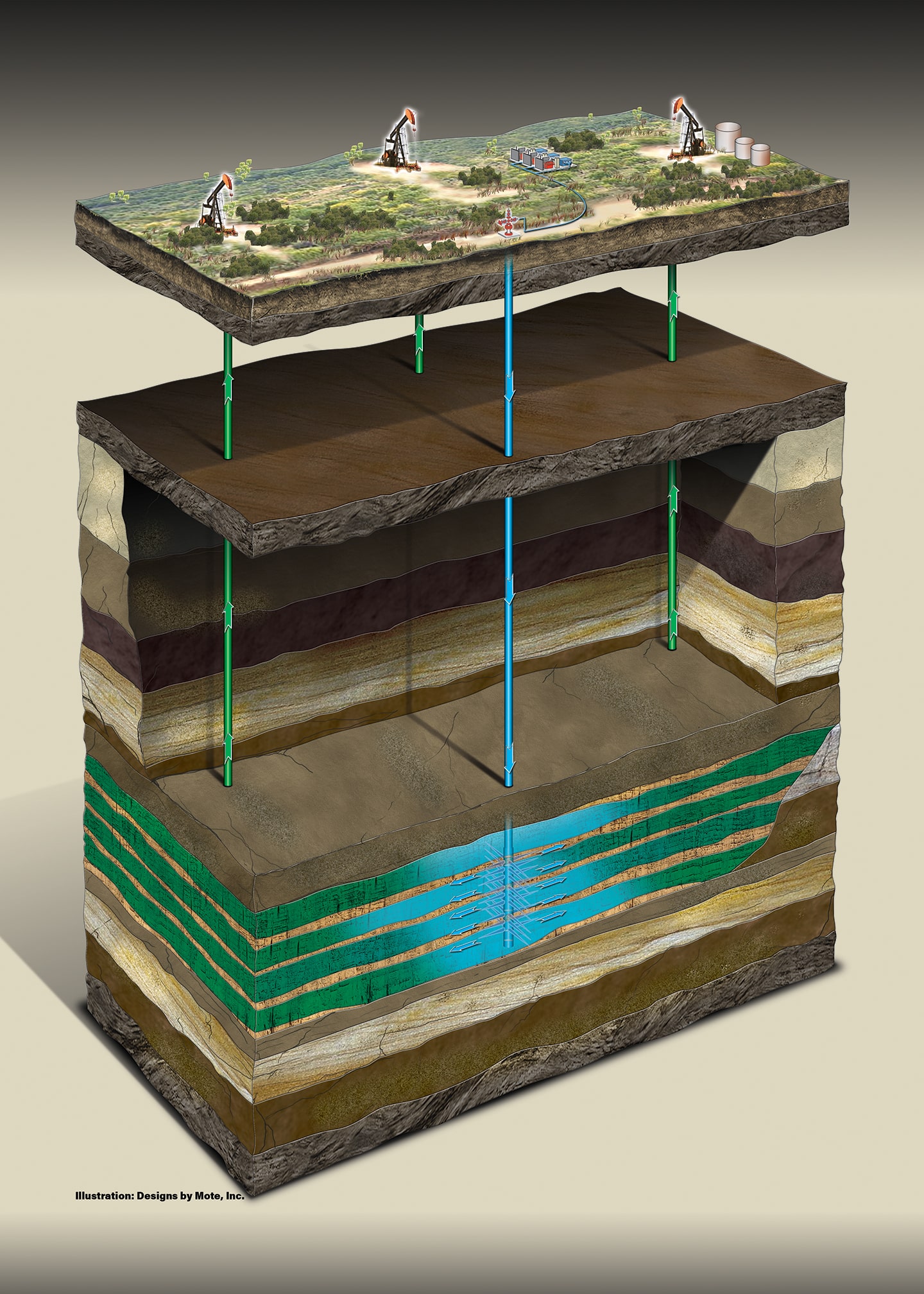
Description
Course Outline
FACTORS CONTROLLING WATERFLOOD RECOVERY
Initial oil in place, displacement sweep efficiency, areal sweep efficiency, vertical sweep efficiency
REVIEW OF ROCK PROPERTIES AND FLUID FLOW
Wettability, imbibition and drainage concepts, capillary pressure, air permeability, absolute permeability, effective permeability, relative permeability
DETERMINATION OF OIL IN PLACE
Current oil saturation versus initial oil saturation, gas saturation, porosity-permeability cutoffs, net pay determination, calibration of log porosity with core porosity, rock continuity and floodable pay, water floodable pore volume versus primary production pore volume versus total pore volume.
MECHANISM OF IMMISCIBLE FLUID DISPLACEMENT (Displacement Sweep)
Fractional flow equations, frontal advance theory, Buckley-Leverett theory, water saturation distribution, performance before breakthrough, performance after breakthrough, effects of gas saturation, fillup time
FLOOD PATTERNS AND AREAL SWEEP EFFICIENCY
Mobility ratio, basic flood patterns (line drive, five-spot, nine-spot, etc.), irregular patterns, peripheral patterns, iso-potential lines, streamlines, areal sweep efficiency, pattern selections
RESERVOIR HETEROGENEITY
Vertical permeability variation, areal permeability variation, detection of stratification, selection of layers, Dykstra-Parsons coefficient, effect of cross flow, vertical sweep efficiency
INJECTION RATES AND PRESSURES
Fluid injectivity, effect of mobility ratio, gas saturation, patterns and formation damage, pattern injectivity before and after fillup
WATERFLOOD PERFORMANCE PREDICTION
Dykstra-Parsons (DP) method; Stiles method; Craig-Geffen-Morse (CGM) method; comparison of DP, Stiles, and CGM; numerical models; empirical models
WATERFLOOD SURVEILLANCE
Production testing, production plots, cut-cum graphs, recovery factor versus net injection, floodable pore volume versus primary production pore volume, transient pressure testing, step-rate tests, Hall plots, injection profile management, pattern balancing, volumetric sweep determination, injection water quality
PLANNING A WATERFLOOD
Starting time, reservoir description, PVT data, primary production, gas saturation, patterns, injection water availability and compatibility tertiary recovery
Reviews
There are no reviews yet.